Piezoelectric actuators are a natural fit for precision motion control applications in semiconductor metrology and inspection. They provide the resolution and fast response needed for fine positioning and autofocus, often working alongside motorized stages that handle long-travel motion and wafer transport.
The challenge is that piezo material behaves nonlinearly. Hysteresis makes displacement dependent on the direction and history of the applied voltage, while creep can cause slow position drift under constant input. Both effects can also change with temperature, humidity, and aging. For applications that require accurate dynamic tracking, these behaviors need to be corrected.
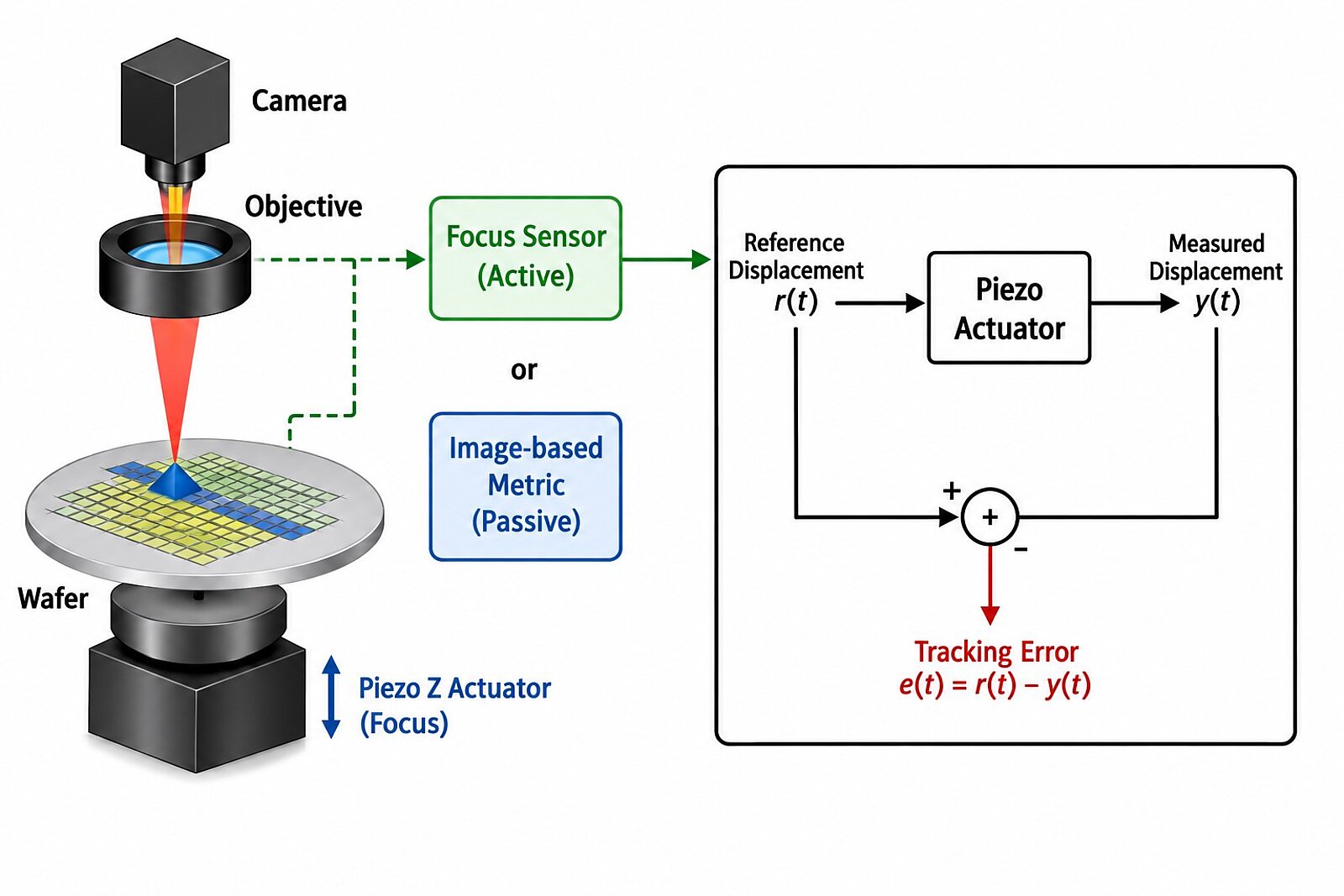

Engineers at PI's Singapore Innovation Center investigated a different approach: learn the actuator behavior directly from measured input-output data and use an inverse model to predict the voltage sequence required to produce a desired motion. That prediction can then be used as a feedforward command alongside conventional feedback control.
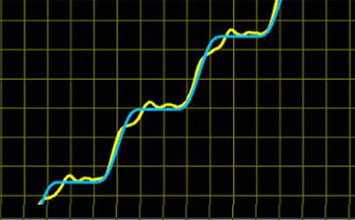
In experiments on a P-621 PIHera nanopositioning stage, the combined approach achieved a mean tracking error of 0.13% of full-scale range.
Why Feedback Alone Has Its Limits
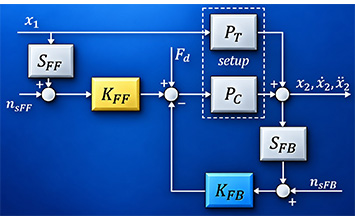
A feedback controller responds to the difference between commanded and measured position. Feedback is therefore useful for correcting tracking errors and rejecting disturbances. In the experimental controller described feedback provides stabilization and disturbance rejection.
Feedforward addresses another part of the problem. If the actuator's behavior can be modeled accurately, the required command can be calculated in advance to compensate for predictable nonlinear behavior.
That is particularly useful with piezo actuators because hysteresis is path dependent. Displacement depends not only on the current input but also on input history and direction.
Traditional approaches, such as Prandtl-Ishlinskii models, represent hysteresis using a superposition of play operators and can be used as invertible feedforward compensators. However, they require operator banks and dedicated calibration. When actuator dynamics are included, the hysteresis model may also need to be cascaded with a separately identified dynamic element.
The PI team investigated whether hysteresis and actuator dynamics could instead be learned end-to-end from measured input-output data.
A Model Designed Around Piezo Behavior
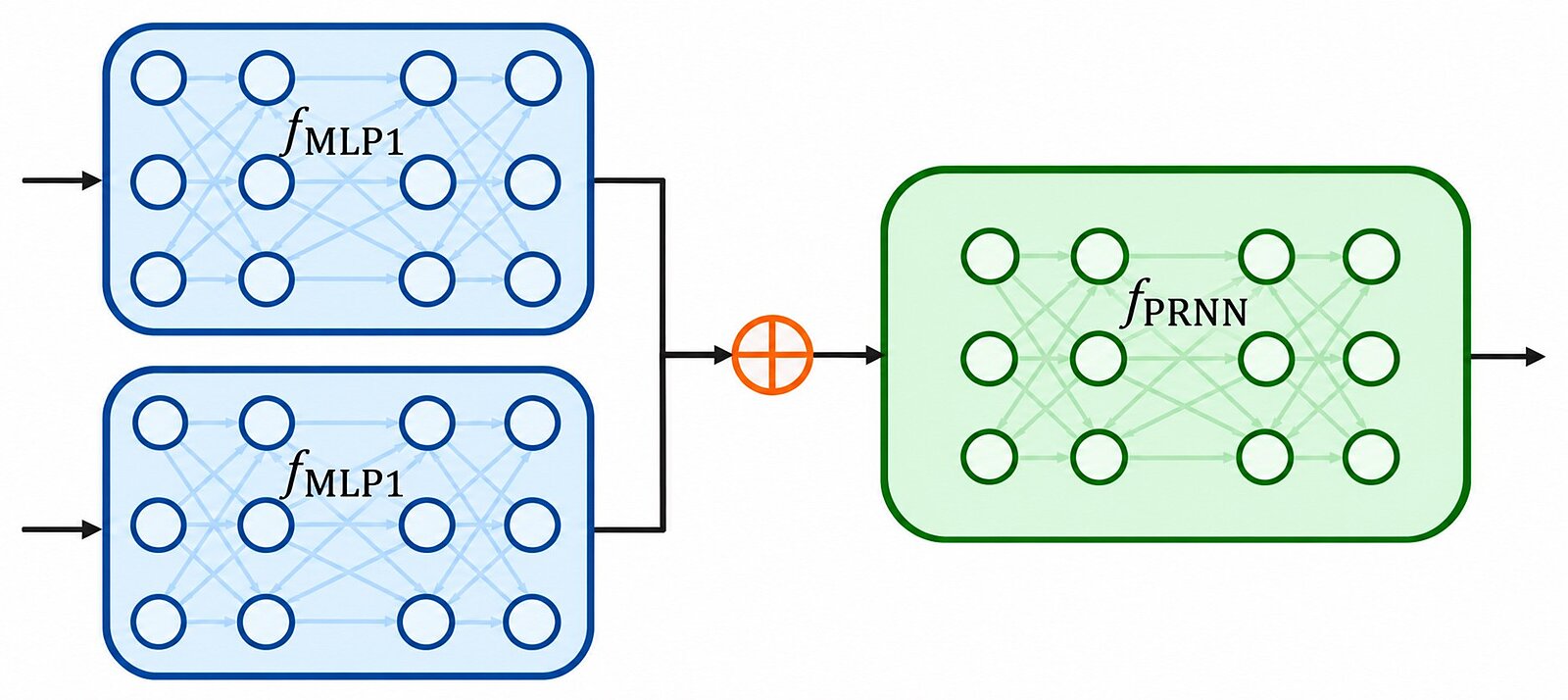
The resulting architecture is called Play Recurrent Neural Network Hammerstein, or PRNN-H. Rather than treating the actuator entirely as a generic black box, PRNN-H combines a recurrent hysteresis module that encodes path-dependent memory with a module for more general actuator dynamics. These modules are cascaded in a Hammerstein-type structure and trained together from input-output data, without requiring access to the intermediate signal between them. The general-dynamics module itself uses a parallel two-path structure for input-side and output-history processing.
Training on One Type of Motion, Testing on Another
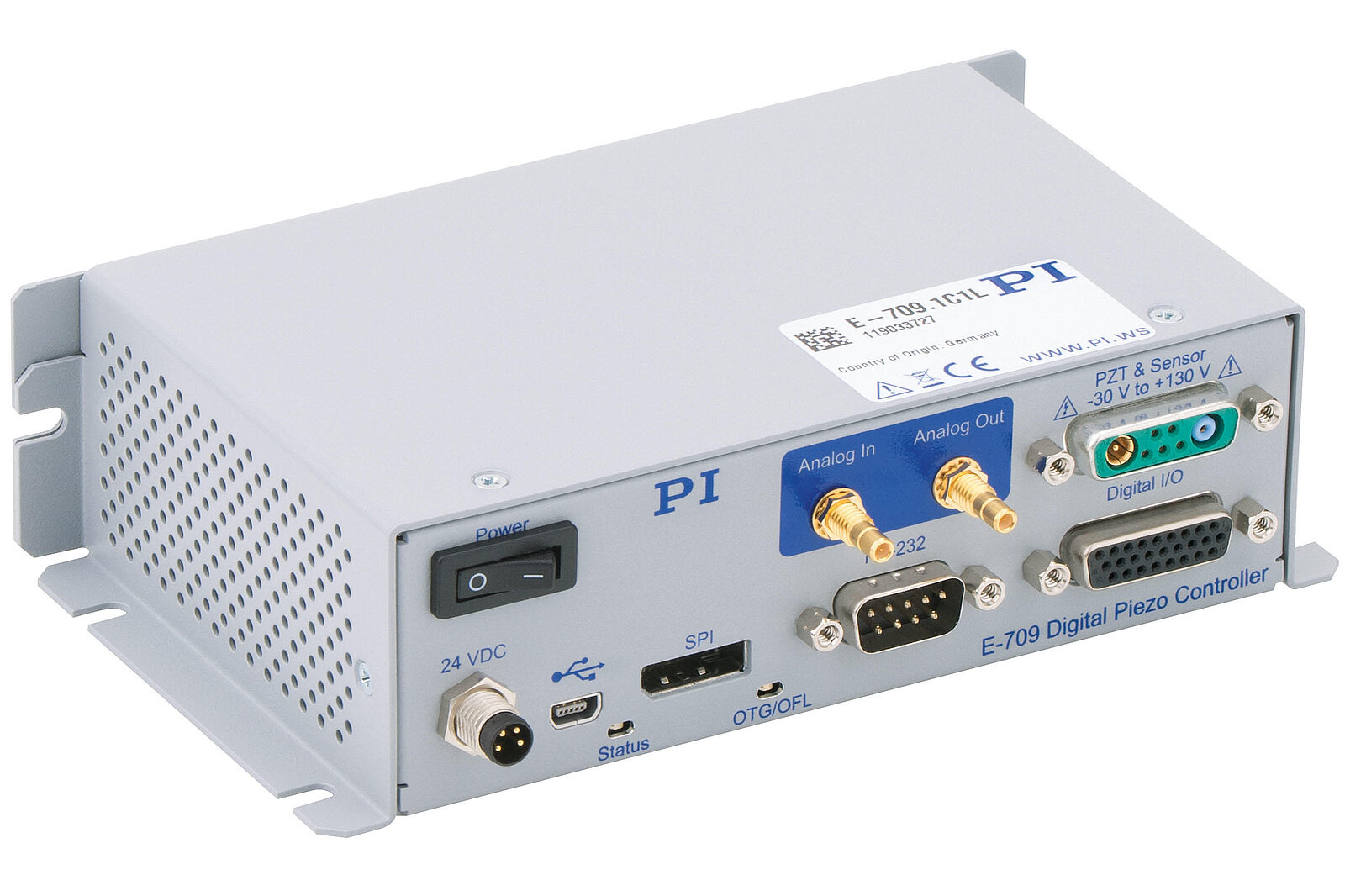
The models were trained offline using measurements from a PI P-621 PIHera Z-stage driven by a PI E-709 digital piezo controller in open-loop mode.

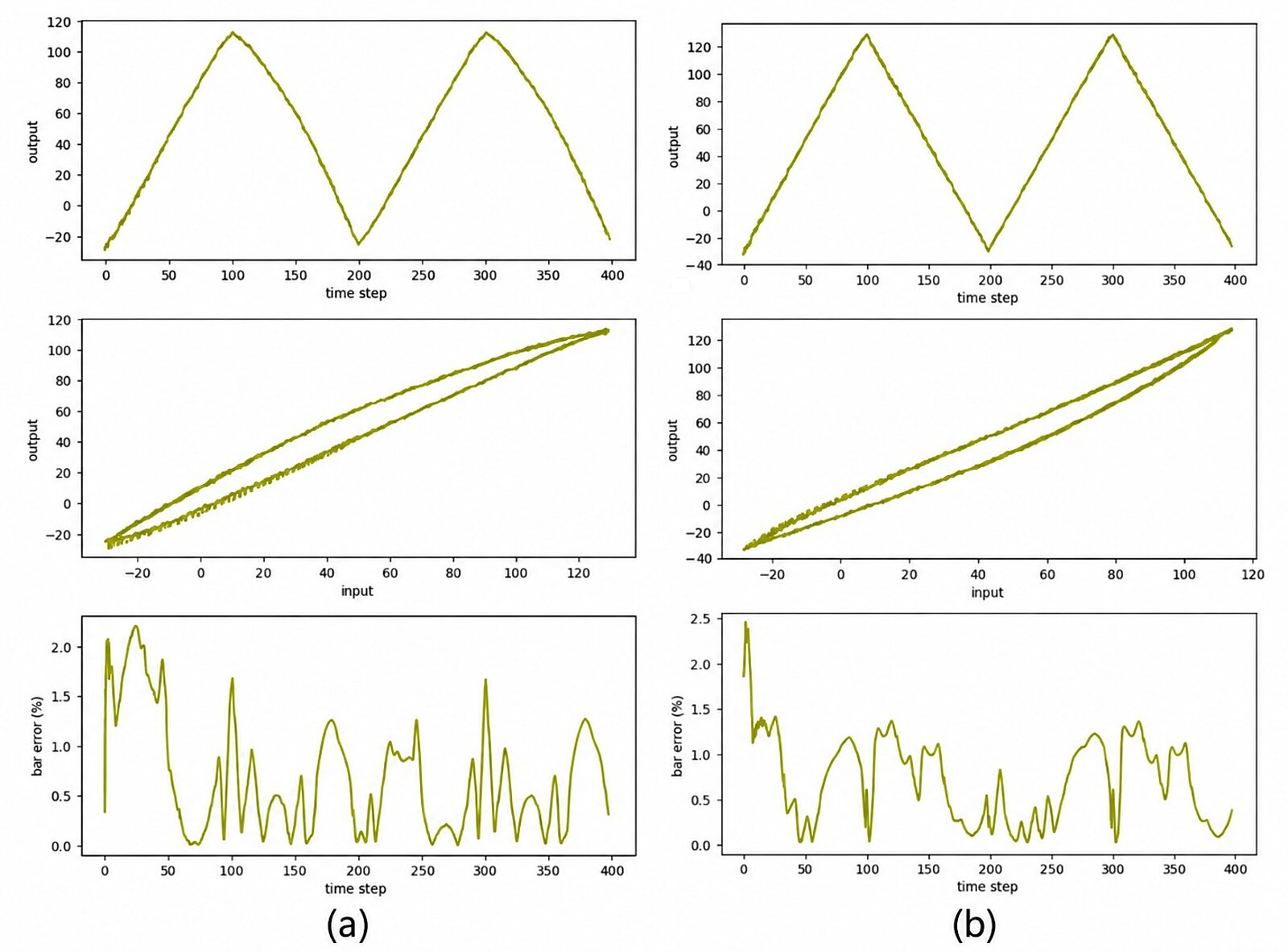
The dataset consisted of 50 multisine trajectories, split 80/20 by trajectory into training and validation sets. The final test trajectory was a 2 Hz full-range triangular wave that was not used for either training or validation. It therefore represented a different waveform class from the multisine training data.
Two versions of the model were evaluated.
The forward model takes the history of actuator inputs and predicts displacement. On the held-out trajectory, it achieved an Mean Absolute Error (MAE) of 0.68% of full-scale range.
The inverse model starts with the desired output trajectory and estimates the input voltage sequence required to produce it. It achieved 0.71% MAE.
For feedforward control, this inverse relationship is particularly useful because it converts a desired trajectory into a voltage profile designed to compensate for the actuator's nonlinear response.
First Test: Feedforward Without Feedback
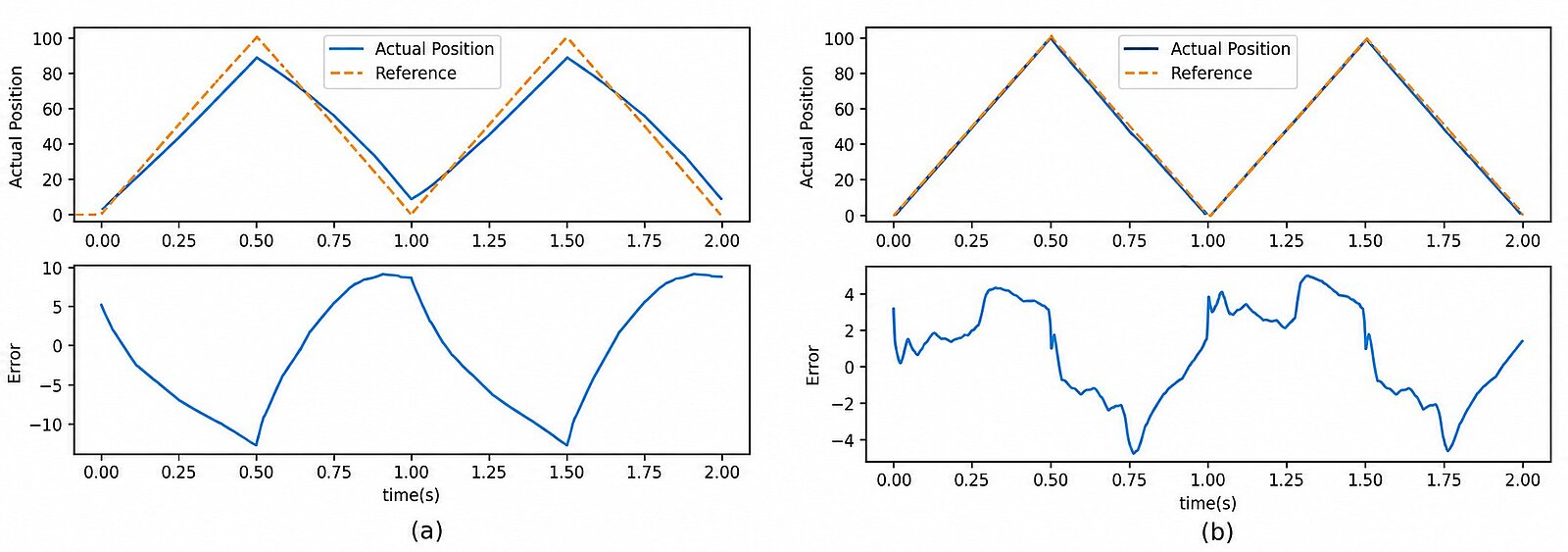
The researchers first tested the inverse model as an open-loop trajectory shaper, making it possible to measure the contribution of learned feedforward without feedback control.
With the E-709 operating open loop and no model-based compensation, the piezo actuator showed pronounced hysteresis. Peak errors reached approximately ±12 µm over the 100 µm range, with an MAE of 6.38% of full-scale range.
With PRNN-H feedforward shaping, MAE fell to 1.63%, a reduction of approximately 74%.
The important point is that the model is not increasing feedback gain. There is no feedback correction in this test. Instead, the inverse model reshapes the voltage command to pre-compensate for the dominant hysteresis before the motion occurs.
Combining Learned Feedforward with Fast Feedback
The next step combined learned feedforward with conventional closed-loop control.
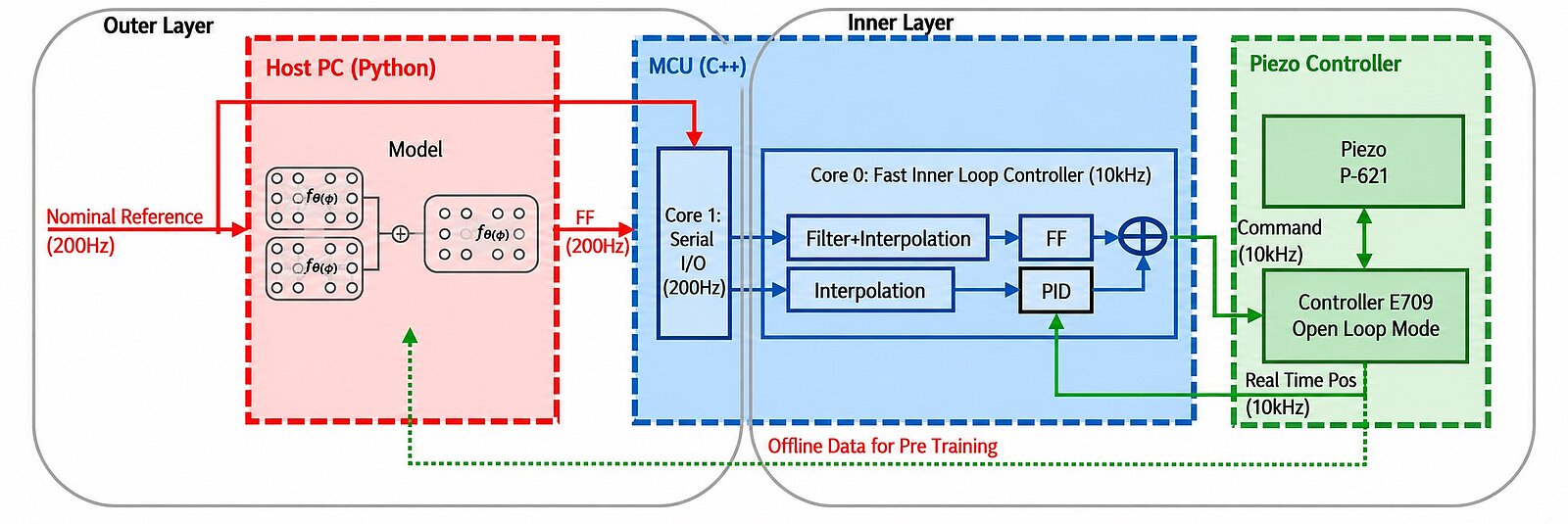
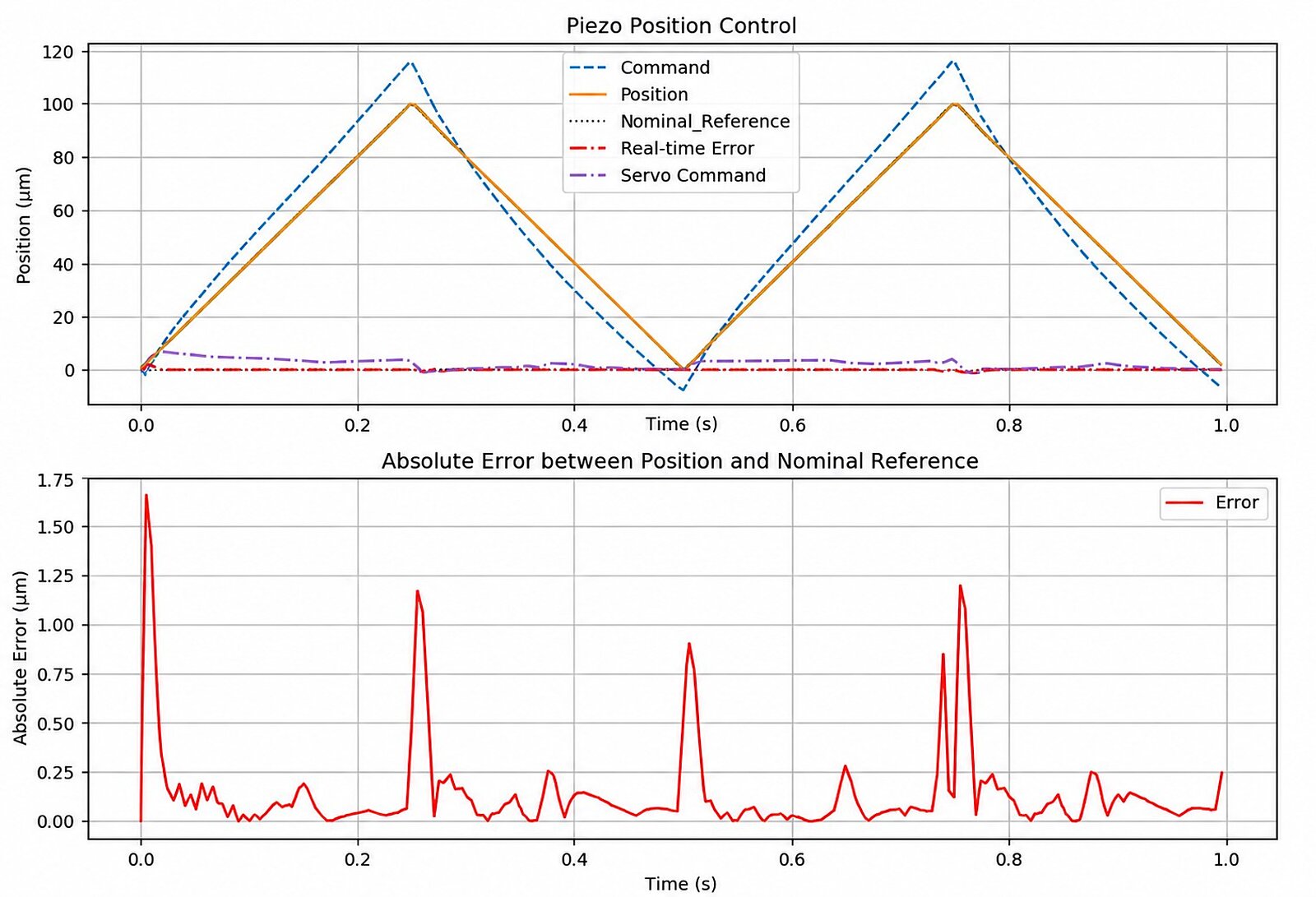
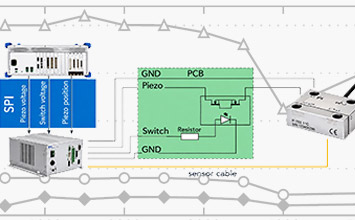
The researchers developed a pseudo-real-time dual-layer, dual-core architecture that allowed the computationally heavier model inference to remain on a host PC while time-critical control functions ran on a microcontroller (MCU).
The host PC runs the inverse model at low frequency and sends updated feedforward commands to the MCU. One MCU core handles communication with the host, while the other runs the fast feedback-feedforward loop and PID feedback. The feedforward command is interpolated and filtered before being applied. The paper states that this interpolation brings the feedforward command into the 10 kHz MCU control loop.
The system is described as pseudo-real-time because the host PC uses a general-purpose operating system rather than a deterministic real-time environment.
The architecture in Figure 3 makes this division clear: model inference runs in the outer PC layer, while the MCU provides the time-critical interface to the E-709 and P-621.
Tracking Error Drops to 0.13%
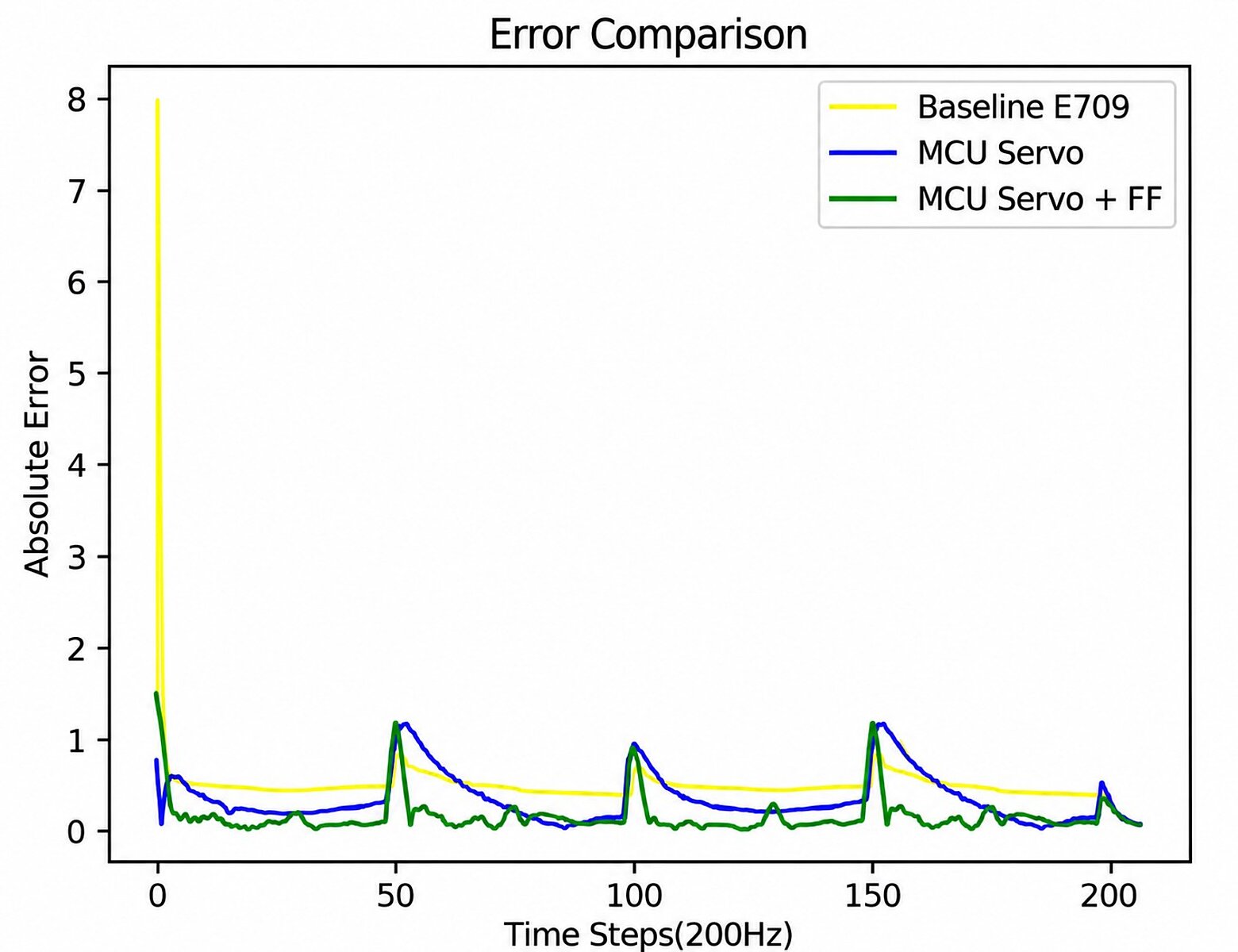
The final experiment compared three closed-loop configurations:
Control configuration | MAE, full-scale range |
E-709 servo baseline | 0.49% |
MCU servo only | 0.31% |
MCU servo + PRNN-H feedforward | 0.13% |
The complete feedforward-plus-feedback controller reduced MAE by 58% compared with the MCU-only ablation baseline and by 73% compared with the E-709 servo baseline.
The progression across the experiments is useful:
- E-709 open loop: 6.38%
- PRNN-H open-loop feedforward shaping: 1.63%
- E-709 closed-loop servo: 0.49%
- MCU closed-loop servo: 0.31%
- MCU servo + PRNN-H feedforward: 0.13%
This makes the role of the learned model clearer. It does not replace conventional feedback. The inverse model provides feedforward compensation for predictable actuator behavior, while feedback stabilizes the system, rejects disturbances, and corrects remaining tracking error.
What This Means for Precision Motion
For semiconductor metrology, inspection, and other dynamic nanopositioning applications, positioning performance depends on more than the mechanical resolution of the stage. Actuator behavior, sensing, control electronics, and the control algorithm all contribute to tracking performance.
This work demonstrates a practical way to add learning-based compensation without requiring dedicated real-time equipment for the experimental implementation. PRNN-H learns the actuator's nonlinear dynamics and hysteresis from input-output data, while the reported sub-millisecond inference time keeps its computational requirements relatively low.
Just as important, the experiments show that learning-based feedforward and conventional feedback can be complementary. Feedforward compensates for predictable actuator behavior, while feedback handles stabilization, disturbances, and residual tracking error.
On the P-621 test system, that combination achieved an MAE of 0.13% of full-scale range, compared with 0.31% for MCU feedback alone and 0.49% for the E-709 servo baseline.
That is the more meaningful takeaway: the learning model did not replace the servo. It improved tracking by giving the servo a better-shaped command to work with.
» Read the full PDF paper by Xin Meng, Brendon Leong, Tze Howe Charn



Blog Categories
- Aero-Space
- Air Bearing Stages, Components, Systems
- Astronomy
- Automation, Nano-Automation
- Beamline Instrumentation
- Bio-Medical
- Hexapods
- Imaging & Microscopy
- Laser Machining, Processing
- Linear Actuators
- Linear Motor, Positioning System
- Metrology
- Microscopy
- Motorized Precision Positioners
- Multi-Axis Motion
- NanoAutomation
- Nanopositioning
- Photonics
- Piezo Actuators, Motors
- Piezo Mechanics
- Piezo Transducers / Sensors
- Precision Machining
- Semicon
- Software Tools
- UHV Positioning Stage
- Voice Coil Linear Actuator
- X-Ray Spectroscopy